
Many customers pay close attention to ingress protection ratings when purchasing explosion-proof products. What exactly is an ingress protection rating, and in industrial applications, what are the differences between IP56, IP66, and IP67? Many...
Many customers pay close attention to ingress protection ratings when purchasing explosion-proof products. What exactly is an ingress protection rating, and in industrial applications, what are the specific differences between IP56, IP66, and IP67? Since many customers still have questions, today we summarize and explain the exact differences among IP56, IP66, and IP67.
The IP (INGRESS PROTECTION) rating system was drafted by the IEC (INTERNATIONAL ELECTROTECHNICAL COMMISSION) to classify electrical equipment according to its dustproof and moisture-proof characteristics. An IP protection rating consists of two digits: the first digit indicates the level of protection against dust and foreign object ingress (where foreign objects include tools, human fingers, etc., preventing contact with live internal electrical parts to avoid electric shock), and the second digit indicates the degree of sealing against moisture and water immersion. Larger numbers indicate higher protection levels.
Accordingly, an IP56 rating means: in dust protection, it prevents foreign object ingress and, while not completely dust-tight, the amount of dust entering will not affect normal operation of the electrical equipment; in water protection, it protects against powerful water jets sustained for at least 3 minutes. An IP66 rating means: in dust protection, it completely prevents foreign objects and dust ingress; in water protection, it protects against powerful water jets sustained for at least 3 minutes.
An IP67 rating means: in dust protection, it completely prevents foreign objects and dust ingress; in water protection, it protects against the effects of immersion in water up to 1 meter deep for 30 minutes.
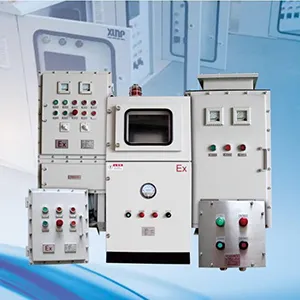
KAIWEI's BXPK-1 positive-pressure explosion-proof electrical control cabinet is a composite explosion-proof system integrating positive-pressure, intrinsic safety, and flameproof technologies. Featuring advanced structure, simple operation, and high safety and reliability, it can be widely used in Zone 1 and Zone 2 hazardous locations containing explosive gas mixtures of Class IIA-IIC and Temperature Group T1-T4.

KAIWEI explosion-proof cabinets maintain the pressure inside the main chamber at 200 Pa via a micro-positive-pressure control system to create a safe environment, supplying power to instruments and automatically powering control instruments on and off to meet positive-pressure explosion-proof requirements: 1) automatic delayed purging, 2) automatic power-on, and 3) automatic power cut-off upon pressure loss. KAIWEI positive-pressure explosion-proof electrical control cabinets offer left-right or upper-lower main/auxiliary cabinet configurations. The main cabinet is a positively pressurized sealed chamber with front (or rear) doors and a front viewing window, while the auxiliary cabinet houses the positive-pressure pneumatic control system. Features include automatic pre-opening purging, purge delay, automatic air replenishment, and automatic positive-pressure range control. Operation is simple and convenient—once purging finishes, the system immediately enters “positive-pressure operation” mode. It provides safety interlock protections including upper/lower positive-pressure protection, audible and visual alarms, automatic power-off at critical low pressure, door-open power-off, and emergency manual power-off. Inside the cabinet, various instruments, VFDs, PLCs, soft starters, and computer control systems can be installed, supporting both local and remote control.

The equipment has passed inspection by the Explosion-Proof Electrical Product Quality Supervision and Inspection Center and complies with GB3836.1-2000 “Electrical Apparatus for Explosive Gas Atmospheres - General Requirements,” GB3836.2-2000 “Electrical Apparatus for Explosive Gas Atmospheres - Flameproof Enclosure ‘d’,” GB3836.4-2000 “Electrical Apparatus for Explosive Gas Atmospheres - Intrinsic Safety ‘i’,” and GB3836.5-2000 “Electrical Apparatus for Explosive Gas Atmospheres - Pressurized Enclosures ‘p’.”
It features a series of safety interlock functions including automatic purging before startup, automatic power supply upon purge completion, upper/lower positive-pressure protection alarms, and automatic power-off.
Founded in 2004 and located in the international financial hub of Shanghai, KAIWEI's current core businesses include robotic foaming equipment, factory explosion-proof electrical series, electrical automation systems and integration, German-craftsmanship electrical cabinet series, and machine tool suspension arm series. With strong technical expertise, advanced production lines and testing equipment, an extensive sales network, a sound logistics support system, and responsive pre-sales, in-sales, and after-sales service, KAIWEI provides reliable electrical products and control system solutions to numerous domestic and international enterprises.
Service Hotline: 400-8398-006
Shanghai Kaiwei Intelligent Technology (Group) Co., Ltd.
Tel: 021-51827665
Fax: 021-59843899
Website (Http): www.kaiwei-sh.com
E-mail: info@kaiwei-sh.com
Add: No. 336, Lane 399, Kangyuan Road, Zhujiajiao Industrial Zone, Qingpu District, Shanghai

- Ingress Protection Ratings: Differences Between IP56
- IP66
- and IP67
Technical specifications, document scope and sealing performance require project-specific review and sample validation with KAIWEI engineering.
Equipment information Documentation scopeNext step
Discuss your part with KAIWEI
Share the drawing, material and target output for an application review.
Request an application review